Promotion of science
We continuously engage in new ideas beyond our own development work. Among other things, we support ground-breaking methodological and analytical methods which generate new findings in life sciences and medicine. For us, this support is based on a long tradition, the foundations of which were laid as early as 1986 when the SARSTEDT Research Prize was awarded for the first time. In the years that followed, this prize for DM 50,000 was awarded six times to international scientists.
Since 2008, we have been sole supporter of the renowned Research Prize for Biochemical Analysis awarded by the German Society for Clinical Chemistry and Laboratory Medicine (Deutsche Gesellschaft für Klinische Chemie und Laboratoriumsmedizin, DGKL) with a contribution of EUR 50,000. The prize has been awarded for the past 40 years for outstanding scientific achievements in the field of biochemical and molecular analysis.
Winners of the Research Prize for Biochemical Analysis 2008–2026
Prize for Biochemical Analysis 2026: SARSTEDT supports research and innovation
John D. Lambris, PhD and Prof. Dr. Dr. Fabian J. Theis honored
We congratulate John D. Lambris, PhD and Prof. Dr. Dr. Fabian J. Theis on receiving the Prize for Biochemical Analysis.
By supporting the Prize for Biochemical Analysis, SARSTEDT underlines its commitment to advancing research and innovation in biochemical and molecular analysis. The German Society for Clinical Chemistry and Laboratory Medicine (DGKL) presents the prestigious award every two years. Since 2008, SARSTEDT has sponsored the prize with €50,000 for each award cycle. During this period, two of the prize recipients have subsequently been awarded the Nobel Prize. From 1986 to 2000, SARSTEDT had already supported scientific work in laboratory medicine through the SARSTEDT Research Prize, which was endowed with DM 50,000.
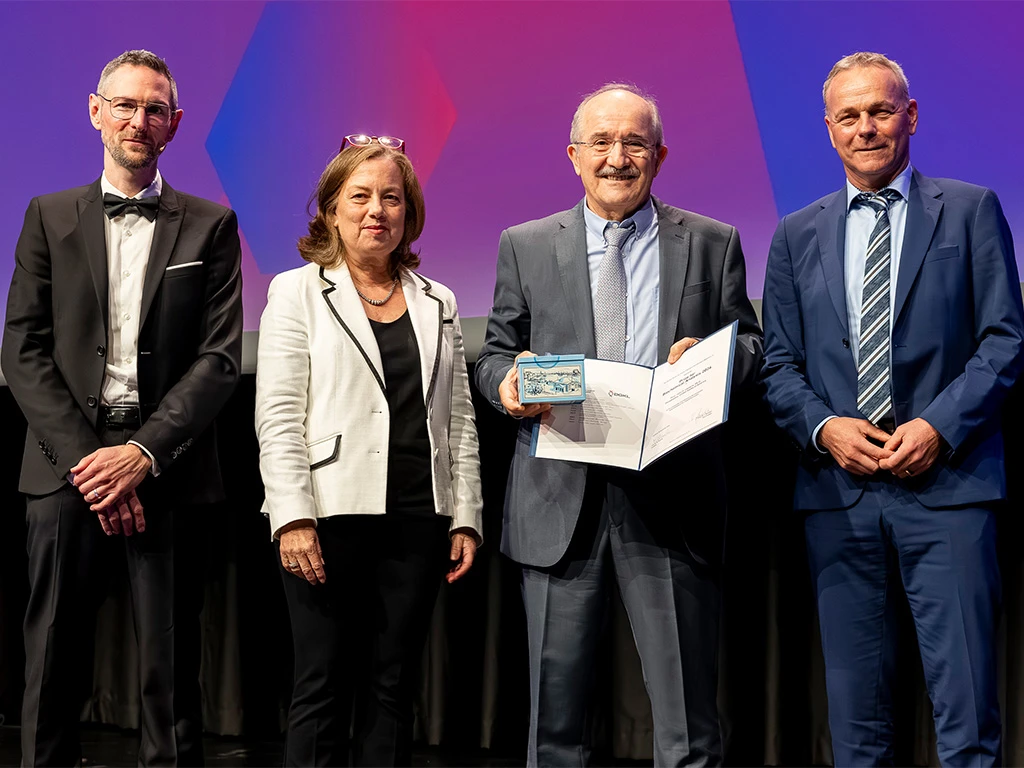
John D. Lambris, PhD is Dr. Ralph and Sallie Weaver Professor of Research Medicine in the Department of Pathology and Laboratory Medicine at the Perelman School of Medicine, University of Pennsylvania (USA). His work has made major contributions to our understanding of the complement system and its role in immune defense and inflammatory processes. His research provides an important foundation for new diagnostic and therapeutic approaches.
From left: Jan Wolter, DGKL Board Member; Mariam Klouche, President of the DGKL; John Lambris, award recipient; Rainer Schuster, SARSTEDT Board Member
Photo: Jan Kulke
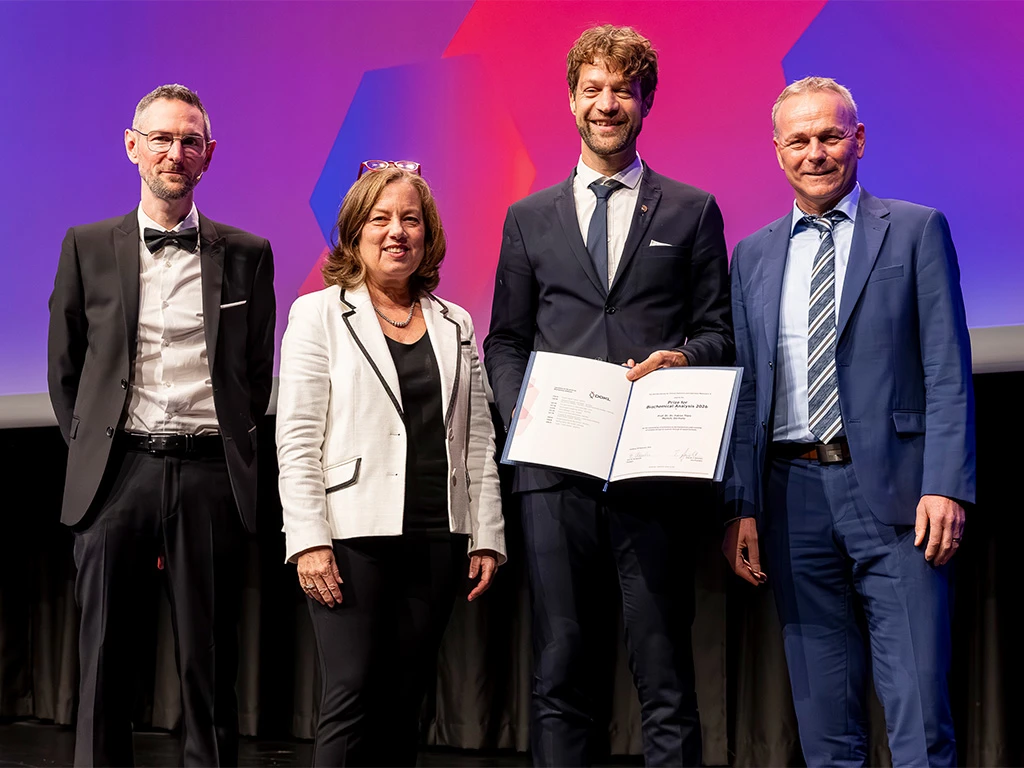
Prof. Dr. Dr. Fabian J. Theis is Professor of Mathematical Modelling of Biological Systems at TUM, as well as Director of the Institute of Computational Biology and Head of the Computational Health Center at Helmholtz Munich (Germany). He is being honored for his pioneering work in artificial intelligence, single-cell genomics and omics medicine. His research demonstrates how large-scale biological datasets can be analyzed to uncover new insights that support more precise diagnostics, risk assessment and personalized therapies.
We look forward to the contributions these research efforts will make to future medical progress.
From left: Jan Wolter, DGKL Board Member; Mariam Klouche, President of the DGKL; Fabian Theis, award recipient; Rainer Schuster, SARSTEDT Board Member
Photo: Jan Kulke
Winners of the SARSTEDT Research Prize 1986–2000
2000
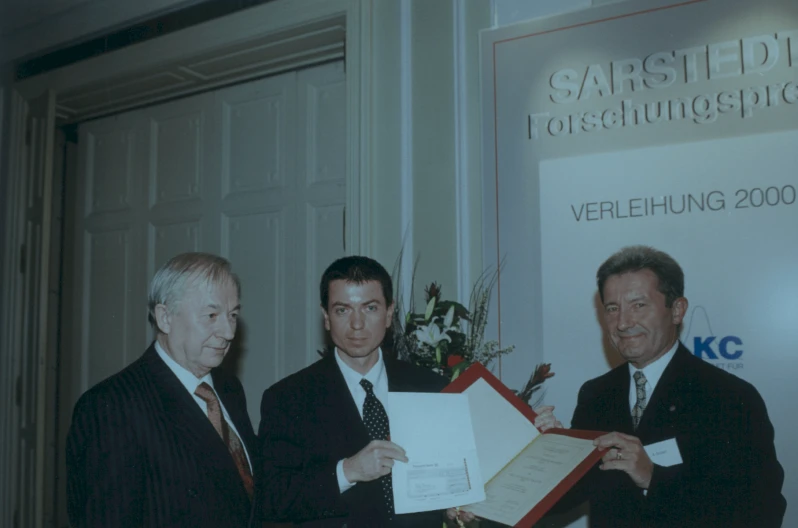
The sixth Sarstedt Research Prize was awarded by the German Society for Clinical Chemistry at the 'Pathogenesis and in-vitro diagnosis of acute and chronic inflammations' symposium in Bonn on 4–5 December 2000.
The Sarstedt Research Prize, worth DM 50,000, was awarded to Prof. Dr. R. Valenta, Head of the Vienna working group 'Molekulare Immunpathologie' ('Molecular immunopathology').
He received the prize for his fundamental work in identifying the genetic structure of allergenic substances. As a result of his work, it is now possible to genetically replicate allergenic substances and use them to produce vaccines, which in turn are used to combat allergies. Unpleasant reactions, for example troublesome pollen or food allergies, could soon be a thing of the past.
The first vaccine tests have already been carried out by Prof. Dr. R. Valenta in cooperation with colleagues in Strasbourg and Stockholm with promising results. The crucial discovery by Prof. Dr. R. Valenta – that mixed allergies, too, depend on just one molecule – makes it possible to technically replicate the structure and blueprint of the molecules.
For more information about our company: